

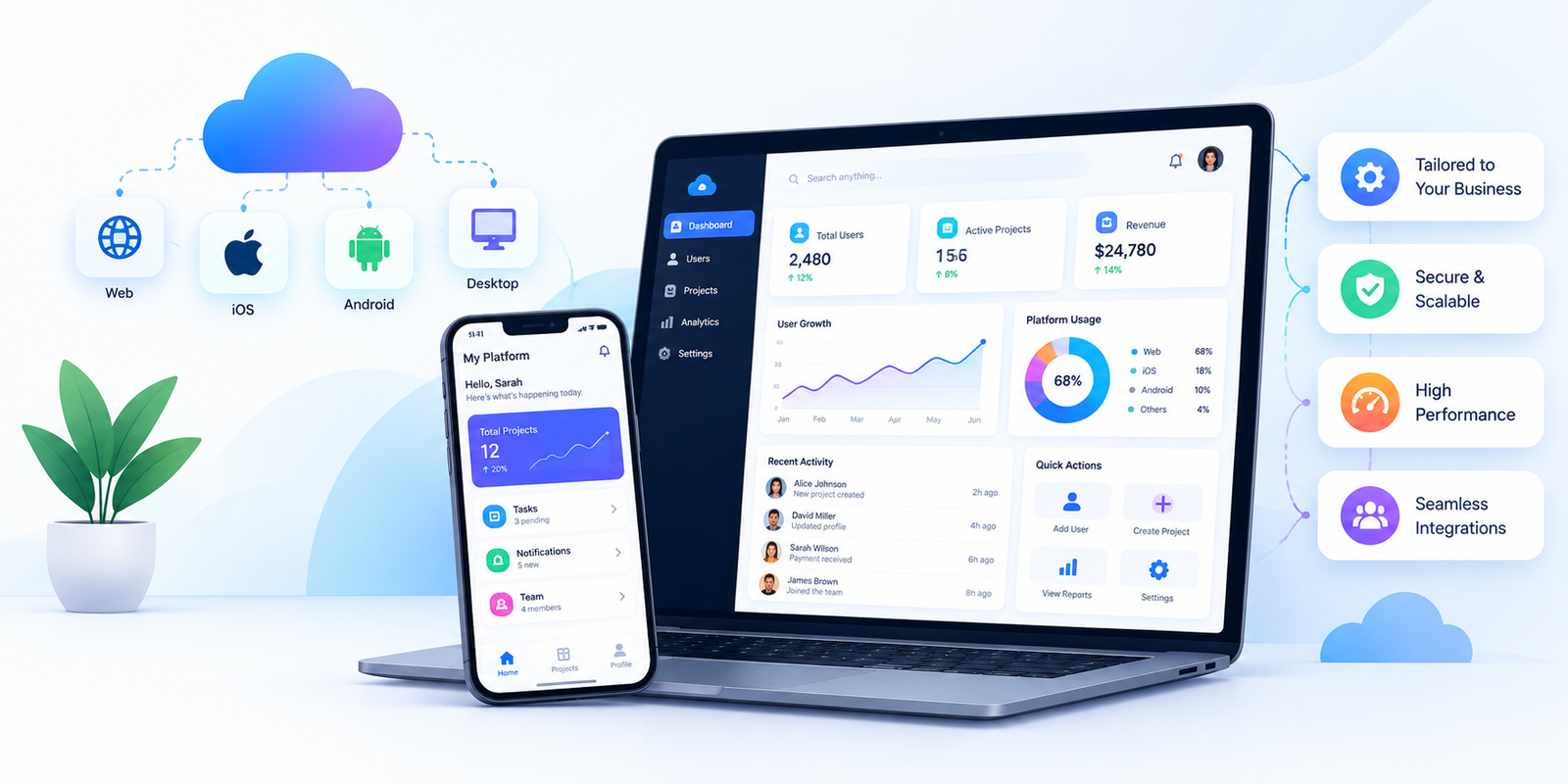
A website shows information. A SaaS product has to run a small business for every one of your customers at the same time. Each account needs its own data, its own users and its own invoice, and all of it has to keep working at 2 a.m. while you sleep. That is the part we build. We start with two questions: how will you charge, and how will customers be grouped? Those answers shape the database, and changing them after launch is the most expensive fix in SaaS.
Who This Is For
Founders who have tested an idea and now need a product people can pay for. Businesses that built an internal tool and want to sell it to others in their industry. Teams whose prototype or no-code app worked for the first fifty users and is now creaking. If you are still validating the idea itself, we will tell you so, and suggest a smaller first step.
What You Get
Every engagement aims at one result: a platform that can take real payments from real customers on launch day.
- Multi-Tenant Architecture. One customer can never see another customer’s data. We choose the isolation model (shared database, separate schemas or separate databases) based on your budget and compliance needs, and explain the trade-off before any code is written.
- Subscription Billing. Monthly and annual plans, free trials, mid-cycle upgrades with prorated charges, automatic retries on failed payments, and GST-ready invoices. We integrate Razorpay, Stripe or the gateway you already use.
- Team Accounts and Roles. Account owners invite colleagues, give them roles like admin, editor or viewer, and remove access when someone leaves. Permissions are enforced on the server, not just hidden in the interface.
- Usage Analytics. An admin panel for you with sign-ups, active accounts, revenue and churn in one place, plus a dashboard inside the product so your customers can track their own usage.
- Cloud Infrastructure That Grows With You. Hosting, automated backups, monitoring and alerts, set up to run ten customers cheaply and to scale to a thousand without a rebuild.
- Support After Launch. Bug fixes, uptime monitoring and new features shipped in planned releases, so your roadmap keeps moving after go-live.
How We Build Your SaaS Product
Four stages, each ending with something you can review and approve before we move on.
Discovery and Architecture 3–5 days
We work through your product logic, pricing plans and how accounts will be structured. You receive an architecture blueprint and a fixed-price proposal.
Product and System Design 2–3 weeks
Screens, user flows, database design and the full billing journey, from sign-up to cancellation. Nothing goes into development until you sign off.
Development and Integrations 4–8 weeks
We build in short cycles and share a working staging link as features land, so you test the product while it takes shape instead of seeing it only at the end.
Testing, Launch and Handover 1–2 weeks
Functional and load testing, production deployment, and clear documentation so your team can run the platform and extend it later.
Before Softxcite, we had a half-built prototype held together with duct tape. They rebuilt the whole platform with proper billing and team accounts, and we signed our first paying customers within weeks of launch.
Yash Trivedi, Co-Founder, LedgerFlow
Frequently Asked Questions
How long does it take to build a SaaS platform?
A first launchable version usually takes 8 to 14 weeks, from discovery to production. A focused MVP sits at the shorter end; products with complex billing, integrations or compliance needs take longer. You get a fixed timeline in the proposal after discovery.
Should I start with an MVP or the full product?
In most cases, an MVP. We build the core workflow, billing and accounts properly, and leave nice-to-have features for later releases. The architecture is planned for the full product, so adding features later does not mean starting over.
Can you rebuild a prototype or no-code app we already have?
Yes. We review what you have, keep what is worth keeping, and plan a migration so existing users and their data move across to the new platform.
Which payment gateways do you integrate?
Razorpay and Stripe are the most common choices for our clients in India and Australia, but we can work with the gateway you already use, as long as it supports recurring payments.